Mental Health Resources to Save for Later: Crisis Lines, Peer Support, Illinois Resources, and Basic Needs Support
By Nhi Vo, LMSW | Clove Counseling, Lisle IL
Last Reviewed: July 12, 2026
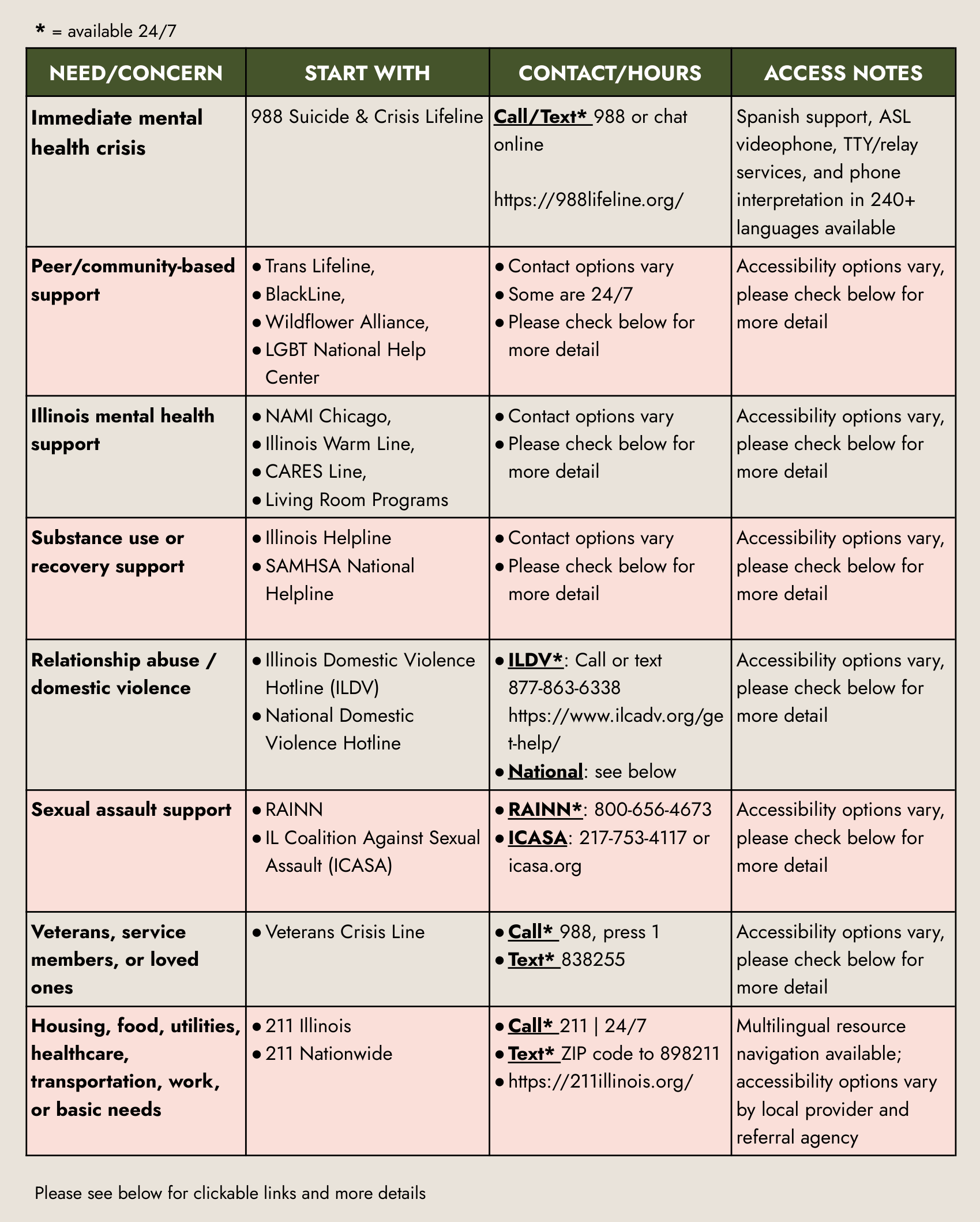
When you or someone you care about is overwhelmed, in crisis, or unsure where to turn, it can be hard to search for help in the moment. This guide gathers mental health, crisis, peer-support, substance use, domestic violence, sexual assault, and basic needs resources in one place.
Some of these resources are available 24/7. Others have limited hours. Some are crisis lines, some are peer-support lines, and some help connect people to practical needs like housing, food, transportation, or healthcare.
This guide is for educational purposes only and is not a substitute for therapy, medical care, legal advice, or emergency services. If you are looking to connect with immediate mental health support, call or text 988. If you are in immediate danger or experiencing a life-threatening emergency, call 911 or go to your nearest emergency room.
A quick note before using any resource
Most of the resources listed below are free to contact unless noted. Standard phone, text, or data rates may still apply, and any services you are referred to may have their own costs.
You have the right to ask:
Is this confidential?
Could emergency services or law enforcement be contacted?
What happens if I share identifying information?
What language options are available?
What accessibility options are available?
Can I use text, chat, TTY, relay, ASL, or an interpreter?
Policies, hours, and access options can change. We do our best to keep this page updated, but it is always a good idea to check the resource’s official website for the most current information.
Understanding 988
Many people have heard of 988 but may not know exactly what it is or how it works.
The 988 Suicide & Crisis Lifeline is a free, nationwide crisis support service available by phone, text, and chat. It connects people experiencing suicidal thoughts, emotional distress, mental health concerns, substance use concerns, or other crises with trained crisis counselors.
988 was created to provide a mental health crisis response option that is separate from 911. For many people, it can be a helpful first step when they need immediate emotional support, help staying safe, or guidance about what to do next.
988 is available 24/7 and can be used whether you are concerned about yourself or someone else.
Like many crisis services, 988 has policies and procedures designed to respond to situations involving immediate safety concerns. If you have questions about confidentiality, emergency response, or what may happen during a call, you can ask before sharing identifying information.
-
What it offers:
988 is a free, 24/7 crisis support line in the U.S. for people experiencing suicidal thoughts, emotional distress, substance use concerns, or a mental health crisis. You can reach a trained crisis counselor by call, text, or chat.
Contact options:
Call: 988
Text: 988
Chat: 988lifeline.org
Website: 988lifeline.org
Hours: 24/7
Language and accessibility:
Spanish: Call 988 and press 2; text AYUDA to 988; Spanish chat is also available.
Other languages: Phone interpretation is available in 240+ languages by calling 988.
Deaf/Hard of Hearing: ASL videophone is available through 988’s website.
TTY/relay: Use your preferred relay service or dial 711, then 988.
Important note:
988 is designed for mental health crisis support and is different from 911. However, emergency services may be involved in some situations where there is an immediate physical safety threat. You can ask what may happen before sharing identifying information.
-
988 is an important and helpful resource for many people. It offers free, 24/7 crisis support by phone, text, and chat across the United States.
At the same time, mental health support is not one-size-fits-all.
Some people prefer peer-led, identity-specific, or community-based resources. Others may be looking for support that is not crisis-focused, or they may want to connect with someone who shares aspects of their lived experience.
Some people also look for alternatives to crisis resources that may involve emergency services, hospitalization, or law enforcement. This can be especially important for people who have had difficult or traumatic experiences with systems, including some Black, Indigenous, and people of color, LGBTQIA+ people, trans people, disabled people, undocumented people, neurodivergent people, people who use substances, people with psychiatric trauma, and people who have been harmed or dismissed by healthcare or legal systems.
For some people, peer-led or community-led resources feel safer because they may offer support from people with lived experience, shared identity, or a deeper understanding of the communities they serve. Peer support can reduce shame, increase trust, and make it easier to reach out before things become more urgent.
This does not mean 988 or emergency services are “bad.” It means people deserve information, choice, and support that fits their needs, identities, and safety concerns.
-
Because accessibility matters!
Support should be accessible. A crisis resource is only useful if someone can actually use it.
Accessibility can include:
Phone, text, or chat options
ASL videophone or video-based services
TTY or relay services
Language interpretation
Spanish-language support
Websites that are easier to navigate
Safety-exit buttons for people seeking support around abuse
Clear explanations of confidentiality and what happens next
If a resource does not clearly list an access option you need, you still have the right to ask. We also encourage checking the official website because access options can change over time.
Peer-led and community-led support options
-
What it offers:
Trans Lifeline is a peer-support phone line run by trans people for trans and questioning people. You do not need to be in crisis to call.
Contact options:
Call: 877-565-8860
Spanish: Call 877-565-8860 and press 2
Website: translifeline.org/hotline
Hours:
Monday–Friday, 12pm–8pm Central Time
Closed on some holidays.
Language and accessibility:
English and Spanish phone support are listed.
Trans Lifeline currently lists phone support; check the website for current text/chat updates.
Confidentiality and emergency response note:
Trans Lifeline states that it does not call emergency services or law enforcement without a caller’s explicit request, except for certain mandated reporting/legal situations described on its website.
-
What it offers:
BlackLine provides peer support, counseling, space to report mistreatment, and support for people impacted by systemic oppression. BlackLine prioritizes BIPOC communities and uses an LGBTQ+ Black Femme lens.Contact options:
Call/Text: 800-604-5841
Email: info@callblackline.org
Website: callblackline.com
Hours:
BlackLine’s FAQ lists 24/7 support. Check the website for current availability.Language and accessibility:
Call and text options are available.
Check the website for current language and accessibility options.
Confidentiality and emergency response note:
BlackLine states that callers do not have to provide personal information and that calls remain private and are not shared with law enforcement or state agencies. -
What it offers:
Wildflower Alliance offers peer support for people feeling lonely, sad, distressed, looking for resources, or wanting to be heard.Contact options:
Call: 888-407-4515
Hours:
Monday–Thursday, 6pm–8pm Central Time
Friday–Sunday, 6pm–9pm Central TimeLanguage and accessibility:
Phone-based peer support.
Check the website for current language and accessibility options.
Confidentiality and emergency response note:
Wildflower Alliance states that its Peer Support Line does not collect personal information, perform assessments, or call crisis services or police.
Helpful note:
Wildflower Alliance asks callers not to leave voicemail because messages are not checked. If you do not reach someone, try calling again during open hours. -
What it offers:
The LGBT National Help Center provides confidential peer support, information, and local/national resources for LGBTQIA+ people.Contact options:
LGBT National Hotline: 888-843-4564
Online chat: lgbthotline.org/chat
Email: help@lgbthotline.org
Website: lgbthotline.org
Hours:
Monday–Friday, 1pm–10pm Central Time
Saturday, 11am–4pm Central TimeLanguage and accessibility:
Phone, chat, and email options are available.
Check the website for current language and accessibility options.
Confidentiality and emergency response note:
The LGBT National Help Center does not clearly publish a detailed emergency-response or law-enforcement policy on the pages reviewed. Before sharing identifying information, you can ask what information is collected, how confidentiality works, and whether emergency services could ever be contacted.
Illinois Mental Health Support
-
What it offers:
NAMI Chicago’s Helpline offers emotional support, action planning, and help connecting to local mental health resources. You do not need a diagnosis to reach out.Contact options:
Call: 833-626-4244
Text: HELPLINE to 833-626-4244
Chat: Available through namichicago.org/helpline
Website: namichicago.org/helpline
Email: info@namichicago.org
Hours:
Monday–Friday, 9am–8pm Central Time
Saturday–Sunday, 9am–5pm Central TimeLanguage and accessibility:
Call, text, and chat options are available.
Ask about current Spanish-language and accessibility options.
Confidentiality and emergency response note:
NAMI Chicago does not clearly publish a detailed emergency-response or law-enforcement policy on the pages reviewed. Before sharing identifying information, you can ask what information is collected, how confidentiality works, and whether emergency services could ever be contacted.
-
What it offers:
The Illinois Warm Line provides peer and wellness support for people experiencing mental health or substance use recovery concerns. It is not a crisis hotline.Contact options:
Call: 866-359-7953
Hours:
Monday–Saturday, 8am–8pm Central Time, except holidaysLanguage and accessibility:
Language assistance services are listed.
For relay needs, use your preferred relay service or ask about current access options.
Confidentiality and emergency response note:
The IL Warm Line does not clearly publish a detailed emergency-response or law-enforcement policy on the pages reviewed. Before sharing identifying information, you can ask what information is collected, how confidentiality works, and whether emergency services could ever be contacted. -
What it offers:
The CARES Line is Illinois’ mental health crisis line with access to mobile crisis response. It can be used for adults, children, or someone you are concerned about.Contact options:
Call: 800-345-9049
TTY/relay: Dial 711
Website: carescrisisline.com
Hours:
24/7/365Language and accessibility:
TTY/relay access is listed.
Ask about language access when calling.
Important note:
Because CARES can connect people to mobile crisis response, it is a good idea to ask what happens next, who may respond, and whether emergency services or law enforcement could be involved in your situation. -
What they offer:
Illinois Living Room Programs are crisis-respite spaces designed to offer support in a calm, home-like setting. They may be an alternative to emergency rooms or hospitalization when appropriate.Contact options:
Search: Illinois DHS Living Room Programs
Website: dhs.state.il.us
Hours:
Hours and contact information vary by location. Some locations may have extended or 24/7 availability.Language and accessibility:
Options vary by location.
Contact the specific Living Room Program to ask about accessibility, language support, transportation, eligibility, and what to expect.
Substance Use & Recovery Support
Substance use and mental health are often connected. People may use substances to cope with trauma, stress, anxiety, depression, chronic pain, isolation, or unsafe environments. Substance use can also increase shame, disconnection, health risks, relationship stress, and barriers to care.
Support should be nonjudgmental, about safety, harm reduction, treatment options, dignity, and choice.
-
What it offers:
The Illinois Helpline connects Illinois residents to substance use treatment, recovery, and harm reduction services. It can also help people seeking support for opioid use disorder, alcohol use disorder, and other substance-related concerns.Contact options:
Call: 833-234-6343
Text: HELP to 833234
Chat: Available through helplineil.org
Website: helplineil.org
Hours:
24/7Language and accessibility:
The website includes a Spanish option.
Check the website for current accessibility options.
Additional note:
Illinois Helpline also offers MAR NOW, a program that can help eligible Illinois residents access medication-assisted recovery for opioid use disorder and alcohol use disorder.Confidentiality and emergency response note:
The Illinois Helpline does not clearly publish a detailed emergency-response or law-enforcement policy on the pages reviewed. Before sharing identifying information, you can ask what information is collected, how confidentiality works, and whether emergency services could ever be contacted. -
What it offers:
SAMHSA’s National Helpline provides free, confidential treatment referral and information for people and families facing mental health and/or substance use concerns. It can help connect callers to local treatment facilities, support groups, and community-based organizations.Contact options:
Call: 800-662-HELP (4357)
TTY: 800-487-4889
Text: Your 5-digit ZIP code to 435748 (HELP4U)
Treatment locator: FindTreatment.gov
Hours:
24/7/365Language and accessibility:
Phone support is available in English and Spanish.
The HELP4U text service is currently available in English.
TTY users can call 800-487-4889.
Confidentiality and emergency response note:
SAMHSA describes the National Helpline as confidential and says it does not ask for personal information. It may ask for your ZIP code or other geographic information to help identify local resources. This is a treatment referral and information service, not a counseling or crisis dispatch line. You can ask what information is collected before sharing identifying details.
Relationship Abuse/Domestic Violence
Domestic violence is deeply connected to mental health. Abuse can affect someone’s sense of safety, self-worth, nervous system, relationships, sleep, concentration, parenting, financial security, and ability to trust themselves or others.
Abuse is not limited to physical violence. It can include emotional abuse, sexual abuse, financial control, threats, intimidation, isolation, stalking, coercion, or using children, immigration status, disability, identity, or mental health against someone.
You do not have to leave a relationship before reaching out for support. Advocates can help you think through options, safety planning, shelter, legal advocacy, and next steps.
-
What it offers:
The Illinois Domestic Violence Hotline provides crisis safety planning, emotional support, referrals to emergency housing, and connections to domestic violence services in Illinois.Contact options:
Call/Text: 877-863-6338
TTY: 877-863-6339
Chat: Available through the Illinois Domestic Violence Hotline website
Hours:
24/7Language and accessibility:
Language assistance is available in 240+ languages.
TTY is available.
People with hearing or speech disabilities may also use 711 relay.
Confidentiality and emergency response note:
The ILDV does not clearly publish a detailed emergency-response or law-enforcement policy on the pages reviewed. Before sharing identifying information, you can ask what information is collected, how confidentiality works, and whether emergency services could ever be contacted. -
What it offers:
The National Domestic Violence Hotline offers free, confidential support, crisis intervention, safety planning, education about relationship abuse, and connections to local resources for people experiencing domestic violence, as well as concerned friends and family. Advocates do not provide direct financial assistance, but they can help connect you with community resources that may support needs like shelter, legal help, counseling, financial aid, or low/no-cost healthcare.Contact options:
Call: 800-799-SAFE (7233)
Text: START to 88788
Chat: thehotline.org
Website: thehotline.org
Deaf/Hard of Hearing ASL support: The Deaf Hotline, video phone 855-812-1001
Deaf/Hard of Hearing instant messenger: thedeafhotline.org
Hours:
24/7/365Language and accessibility:
The Hotline offers access to trained interpreters by phone in 290+ languages. You can tell the advocate what language you prefer and they can connect an interpreter.
Spanish-language website access is available through thehotline.org.
Deaf, DeafBlind, and Hard of Hearing survivors can access 24/7 support through The Deaf Hotline, a partnership between The Hotline and ADWAS.
The Deaf Hotline offers ASL-accessible support by video phone at 855-812-1001, plus instant messenger and email/contact form options.
The Hotline’s Deaf Services page also notes TTY and live chat access for Deaf or Hard of Hearing survivors, but the current page reviewed does not list a separate TTY phone number. Check thehotline.org/get-help/domestic-violence-deaf-services for the most current access details.
Confidentiality and emergency response note:
The National Domestic Violence Hotline describes its services as free, confidential, and available 24/7. Its website also notes that internet use can be monitored and may be impossible to erase completely, so people concerned about digital safety may want to call instead, use the site’s quick-exit feature, and clear browsing history. Before sharing identifying information, you can ask what information is collected, how it is stored, and whether there are any limits to confidentiality. -
What it offers:
The Illinois Coalition Against Domestic Violence is a statewide coalition of domestic violence service providers. It can help people locate domestic violence agencies and services across Illinois.Contact options:
Website: ilcadv.org
Provider directory: available through the ICADV website
Hours:
Directory/resource access online; local program hours vary.Language and accessibility:
Options vary by local provider.
If you need immediate domestic violence support in Illinois, the Illinois Domestic Violence Hotline is the more direct option.
Confidentiality and emergency response note:
The ICADV does not clearly publish a detailed emergency-response or law-enforcement policy on the pages reviewed. Before sharing identifying information, you can ask what information is collected, how confidentiality works, and whether emergency services could ever be contacted.
Sexual Assault Support
Sexual assault and abuse can affect mental health in many ways, including anxiety, depression, PTSD symptoms, shame, dissociation, sleep changes, relationship difficulties, chronic fear, anger, numbness, or feeling disconnected from your body.
Support is available whether something happened recently or many years ago. You do not have to report to police to ask questions, receive emotional support, or learn about your options.
-
What it offers:
RAINN provides confidential support for sexual assault survivors and their loved ones, including emotional support, information, and connection to local resources.Contact options:
Call: 800-656-HOPE (4673)
Text: HOPE to 64673
Chat: rainn.org/hotline
Website: rainn.org
Hours:
24/7Language and accessibility:
English and Spanish support are listed.
Check the website for current accessibility options.
Confidentiality and emergency response note:
RAINN does not clearly publish a detailed emergency-response or law-enforcement policy on the pages reviewed. Before sharing identifying information, you can ask what information is collected, how confidentiality works, and whether emergency services could ever be contacted. -
What it offers:
ICASA is a statewide network of community-based sexual assault crisis centers in Illinois. ICASA centers provide crisis intervention, counseling, and advocacy for survivors of sexual assault and significant others.Contact options:
Phone: 217-753-4117
Find a ICASA crisis center: icasa.org/crisis-centers
Website: icasa.org
Hours:
Each ICASA crisis center operates a 24-hour hotline. Local center contact information varies by location.Language and accessibility:
Options vary by local center.
Contact your nearest ICASA center to ask about language access, disability access, medical advocacy, legal advocacy, and counseling options.
Confidentiality and emergency response note:
ICASA does not clearly publish a detailed emergency-response or law-enforcement policy on the pages reviewed. Before sharing identifying information, you can ask what information is collected, how confidentiality works, and whether emergency services could ever be contacted. -
What it offers:
The Chicago Rape Crisis Hotline provides immediate support, crisis intervention, and referrals for survivors of sexual violence and their loved ones in Chicago and surrounding suburbs.Contact options:
Call: 888-293-2080
Website: ywcachicago.org or ourresilience.org
Hours:
24/7Language and accessibility:
Interpretation services may be available.
Check the provider’s website for current access options.
Confidentiality and emergency response note:
The Chicago Rape Crisis Hotline does not clearly publish a detailed emergency-response or law-enforcement policy on the pages reviewed. Before sharing identifying information, you can ask what information is collected, how confidentiality works, and whether emergency services could ever be contacted.
Veterans & service Members
-
What it offers:
The Veterans Crisis Line provides crisis support for Veterans, service members, National Guard and Reserve members, and people concerned about them. You do not have to be enrolled in VA benefits or healthcare to use the line.Contact options:
Call: 988, then press 1
Text: 838255
Chat: veteranscrisisline.net
Website: veteranscrisisline.net
Hours:
24/7/365Language and accessibility:
TTY for hearing loss: 800-799-4889
Check the website for current language options.
Confidentiality and emergency response note:
The Veterans Crisis Line does not clearly publish a detailed emergency-response or law-enforcement policy on the pages reviewed. Before sharing identifying information, you can ask what information is collected, how confidentiality works, and whether emergency services could ever be contacted.
Basic Needs (Housing, Food, Utilities, healthcare, etc.)
-
What it offers:
211 connects people to local non-emergency health and human service resources. This can include support for housing, utilities, food, healthcare, mental health, transportation, employment, and other social services.Contact options:
Call: 211
Text: Your ZIP code to 898211
Search online: 211illinois.org
Email/contact options: available through 211 Illinois online
Hours:
24/7Language and accessibility:
211 Illinois lists multilingual services by phone, chat, email, and text.
211’s online directory can be useful for people who prefer to search privately or compare options before contacting a provider.
Why it matters:
If someone’s anxiety, depression, trauma symptoms, or stress are worsened by basic needs insecurity, therapy alone may not be enough. Resource navigation can help connect people to supports that make healing more possible. -
Mental health does not exist in a vacuum.
It is harder to feel safe, regulated, connected, or hopeful when someone is also facing housing instability, food insecurity, transportation barriers, lack of healthcare, unsafe relationships, job loss, discrimination, or financial stress.
Support for basic needs is mental health support, too. That is why this list includes 211 and other resource-navigation options in addition to crisis lines.
A final reminder
You deserve support that feels safe, respectful, and right for you.
If you would like to learn more about these resources or explore therapy at Clove Counseling, you are welcome to reach out by clicking the contact button below.
Clove Counseling offers individual therapy and, depending on the clinician, couples or family therapy in person in Lisle, Illinois and online throughout Illinois.