When “Nothing Bad Happened”… But You Still Struggle (Trauma Series Part 2)
By Nhi Vo, LMSW | Clove Counseling, Lisle IL
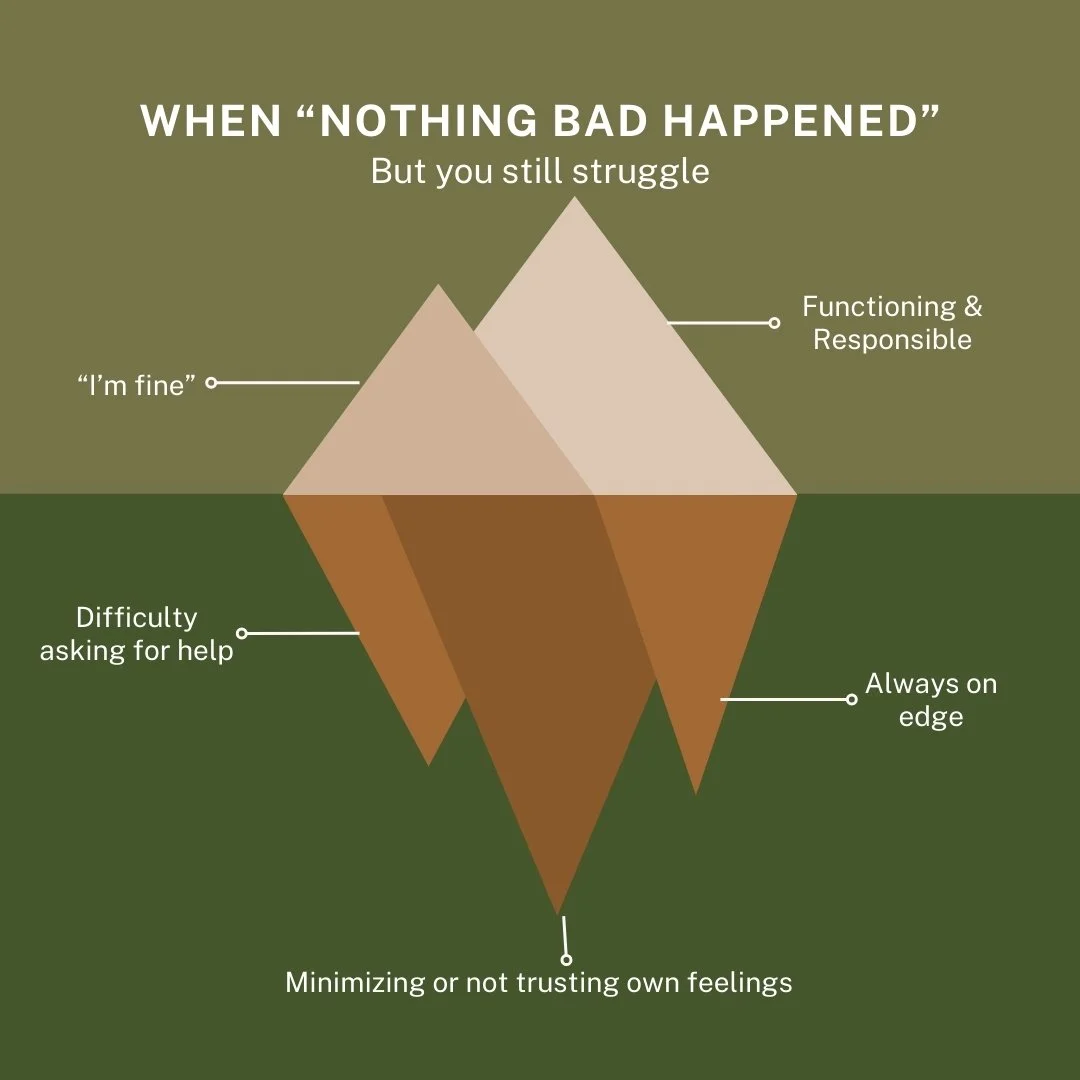
In Part 1 of this series, we explored how trauma is not just about one “big” event. It is about how overwhelming and unsupported experiences shape our nervous system over time ¹ ². Today, we’ll go into more detail about what that might look like.
If you look back at your life and think:
“Nothing really bad happened to me.”
“My parents did their best. I shouldn’t feel this way.”
“I had a roof over my head. Why am I still struggling?”
This post is for you.
Many people feel confused, or even guilty, about their pain because their story doesn’t match what they think trauma is supposed to look like. They minimize their experiences because no one yelled, hit, or “meant to hurt them.”
And yet… something still feels off.
“Nothing Bad Happened” Often Means “Nothing I Was Allowed To Name”
When people say “nothing bad happened,” they usually mean things like:
“No one was obviously abusive.”
“I was not in physical danger.”
“Other people had it much worse.”
Those things may be true, and your nervous system may still be carrying the imprint of experiences like:
having big feelings with no one to help you regulate
being told “you’re fine” when you were overwhelmed
being praised for being “mature” or “easy” while you struggled silently
being the peacemaker in the family
watching a caregiver suffer with depression, illness, burnout, or addiction
growing up in a home where emotions were ignored, mocked, or shut down
These experiences are often invisible from the outside but very real on the inside.
They are sometimes called emotional neglect or developmental and relational trauma. Not because there was one terrible moment, but because over time your emotions and needs did not consistently have a safe place to land ³ ⁴.
Trauma Can Be About What Did Not Happen
Trauma is not only about what was done to you. It can also be about what you needed and did not receive.
For example:
You needed comfort and instead received advice or minimization.
You needed someone to stay calm with you and instead got anger, shutdown, or “go to your room.”
You needed to be a kid and ended up taking care of others.
You needed space to make mistakes and instead felt pressure to be perfect.
None of this requires a “bad guy.” Many caregivers were doing the best they could with what they knew, often while carrying their own unhealed trauma ⁵ ⁶.
Your body does not measure how bad it was compared to someone else’s life. Your body asks a different question: “Did I feel safe, seen, soothed, and supported?” ⁶
If the answer was often “no,” that leaves an imprint.
How This Might Show Up Now
If you grew up in an environment where emotions were not welcomed or supported, you might notice things like:
struggling to trust your own feelings
feeling “too sensitive” or “needy”
difficulty asking for help
feeling guilty when you rest or set boundaries
minimizing your own stress (“I should not be this upset”)
over-functioning and taking care of everyone else
feeling inexplicably anxious, empty, or on edge
You might also have a hard time naming anything that was “wrong” about your childhood. That can deepen shame and sound like:
“If nothing bad happened, then maybe I am the problem.”
You are not the problem. You adapted to the emotional environment you were in.
Your Body Remembers, Even When Your Mind Minimizes
Research shows that emotional neglect and chronic misattunement in childhood are strongly linked to anxiety, depression, and difficulties in adulthood, even when children were never physically harmed ⁴ ⁷.
Your nervous system remembers:
how alone you felt
how much you had to hold in
how safe or unsafe it felt to need anything
So when you are triggered now by conflict, criticism, disconnection, or pressure, your body is often reacting to more than the present moment. It is responding to a lifetime of unsorted experiences.
That does not mean you are broken. It means your body has been working very hard for a very long time.
You Do Not Have To Earn the Right To Your Pain
You do not need a dramatic story to deserve support. You do not have to compare your suffering to anyone else’s to justify why you feel the way you do.
If you are struggling, that is enough. If something hurts, that matters. If you feel confused by your reactions, that is worth exploring.
Your story is valid, even if it does not fit the stereotype of trauma.
The good news is that what was learned for survival can be unlearned, updated, and healed in the presence of safety, connection, and support⁵ ⁸ .
If there are any terms in this article that are unfamiliar, please visit our glossary page to learn more.
Coming Next in This Series
This post is Part 2 in a series exploring trauma and healing more deeply:
Part 3: How Childhood Shapes the Nervous System
Part 4: How Trauma Shows Up in Adulthood
Part 5: What Healing Trauma Actually Looks Like
Want to get notified when Part 3 is published? Subscribe to our blog below.
(Or check back soon — new posts are on the way.)
Curious About Trauma Therapy at Clove Counseling?
If this resonates with you, I’d love to help.
Learn more or schedule a session at:
References
Herman, J. L. (2015). Trauma and Recovery: The Aftermath of Violence, From Domestic Abuse to Political Terror (Updated ed.). Basic Books.
van der Kolk, B. A. (2014). The Body Keeps the Score: Brain, Mind, and Body in the Healing of Trauma. Viking.
Crittenden, P. M. (2016). Raising Parents: Attachment, Parenting, and Child Safety (2nd ed.). Routledge.
Kim, S., et al. (2020). Childhood emotional neglect and adult mental health: A meta analytic review. Clinical Psychology Review.
Perry, B. D., & Winfrey, O. (2021). What Happened to You? Conversations on Trauma, Resilience, and Healing. Flatiron Books.
Siegel, D. J., & Bryson, T. P. (2020). The Power of Showing Up: How Parental Presence Shapes Who Our Kids Become and How Their Brains Get Wired. Ballantine Books.
Schore, A. N. (2019). Right Brain Psychotherapy. W. W. Norton.
Ford, J. D., & Courtois, C. A. (2020). Treating Complex Traumatic Stress Disorders in Adults (2nd ed.). Guilford Press.